Figures with a gentle energy
Panamanian sculptor, Maria Isabel Pino, exemplifies the virtuosity of the sculptural language in her pursuit of a well-executed and serene figurative style.
Her works display a clear classicism, a certain nod to the past—or perhaps, better yet, to a delicate timelessness—as if alluding to what is, in reality, eternal and beyond interpretation. Or perhaps it is a matter of impeccable naturalism due to the gentle energy with which she impregnates her forms.
The fact is that Pino takes as her starting point her delicacy, her contained emotion, her sense of space or the meaning that the human figure takes on within it, her romanticism or poetic sensibility that invades nothing but permeates everything. Her pieces also seem to be imbued with an unusual silence, a kind of exercise in concentration that envelops each piece in its own, unique intimacy.
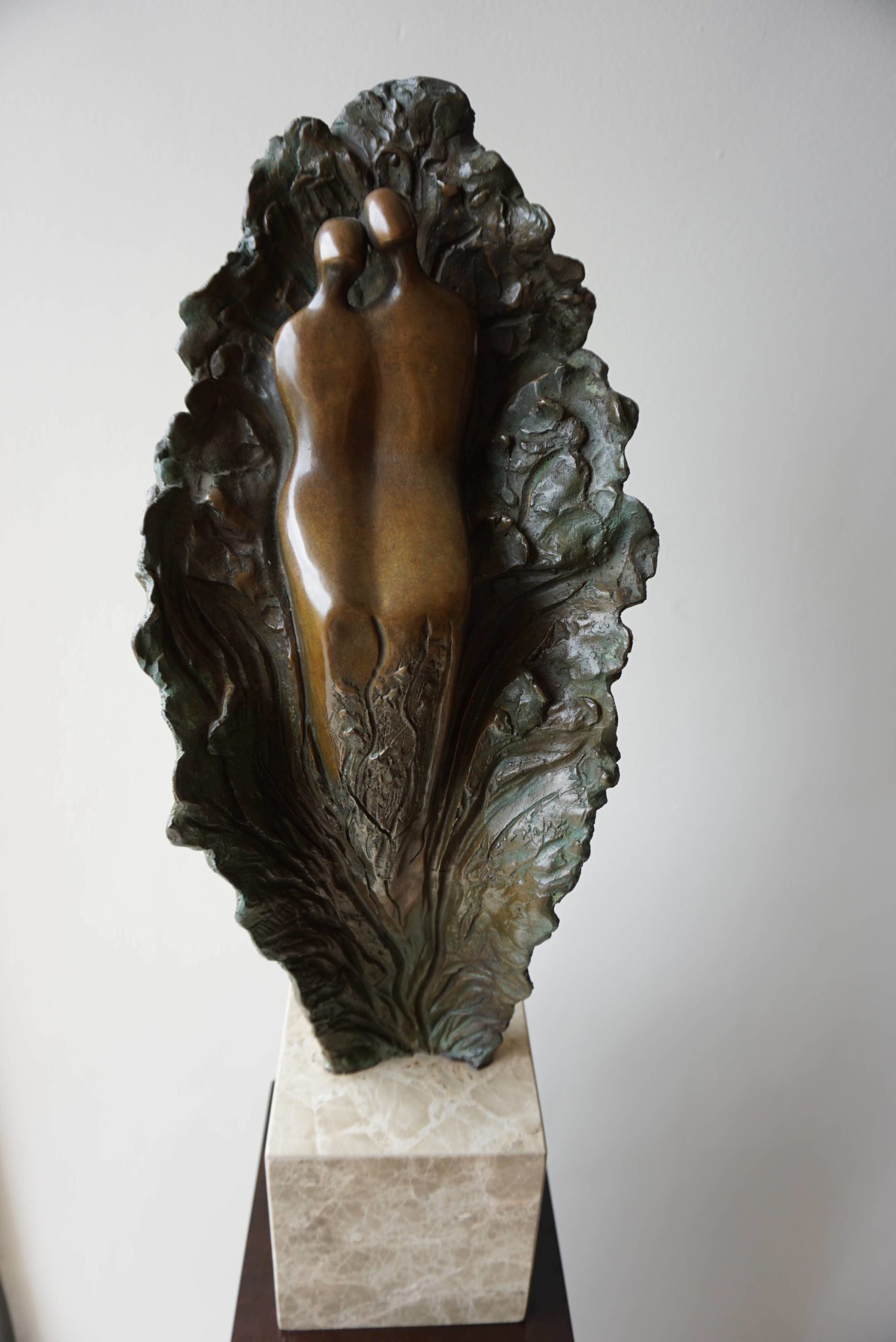
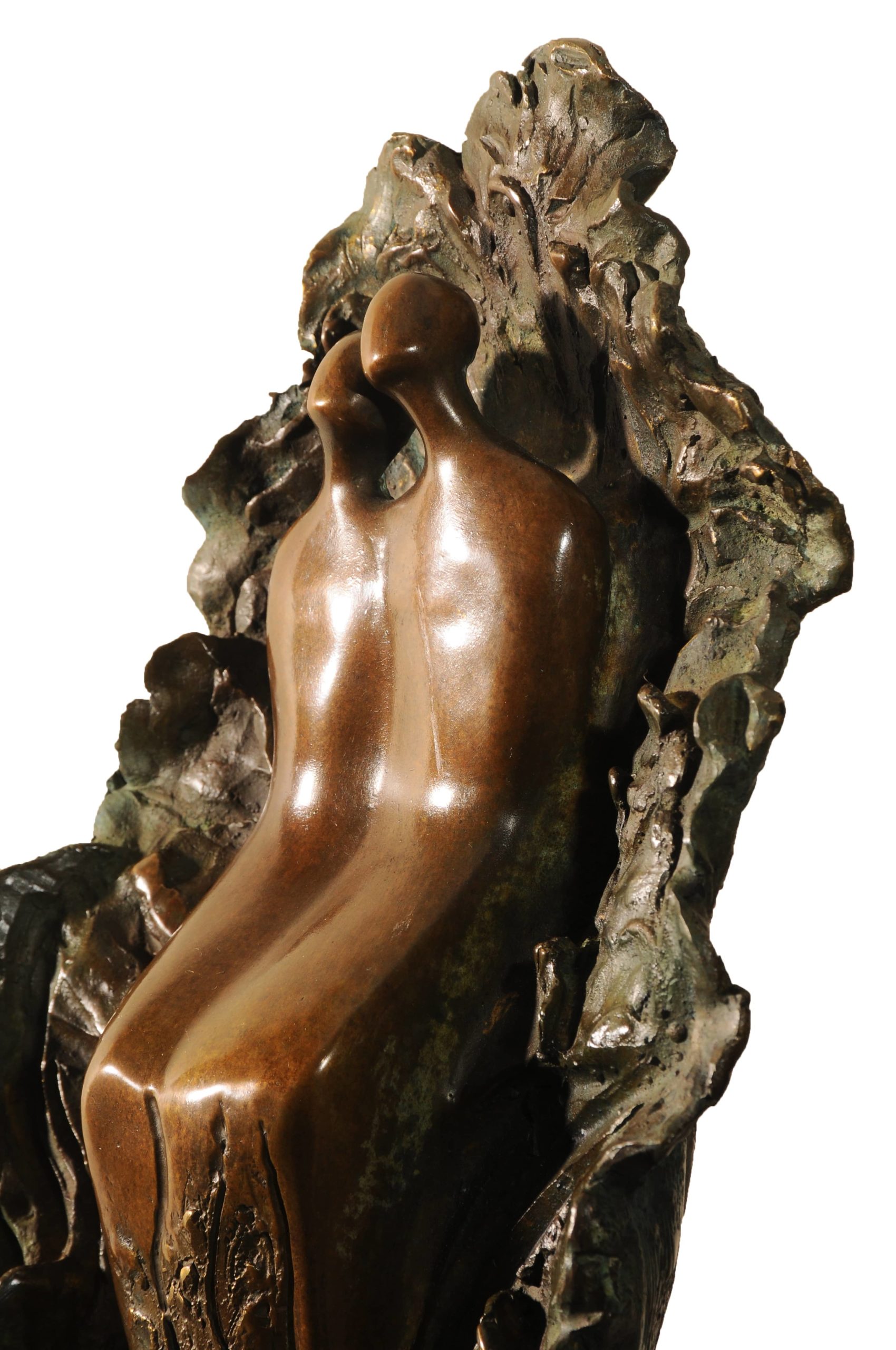
Her work is clearly emotive, with a curious cadence and a profound serenity. And there is perhaps a curious and beautiful effect in her works: it is as if the figure was being born or taking shape practically at the very moment the viewer contemplates it.
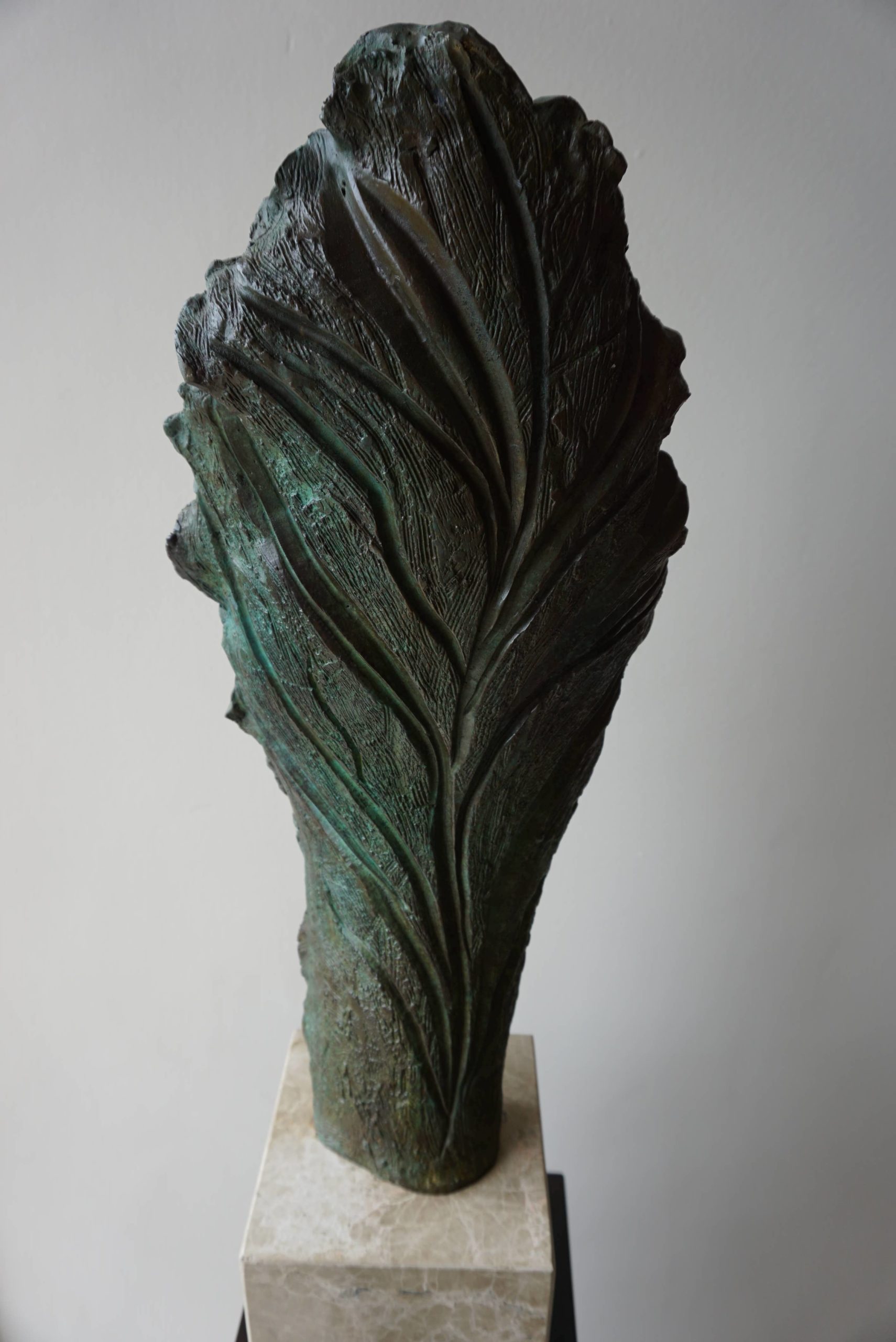
The narrative unfolding in her works seems to invite a subtle discovery—precisely through the gaze—of the power of the figure, of its slow movement, of its relationship with others and with nature, whether because it is emerging from nature or because nature envelops it as the artist portrays and shapes it. In her case, her sculptures retain both that effect of living nature and that of naturalness itself.
The work of a sculptor with a unique creative vision endowed with personal strength and, one might even say, bearing a delicate and simple message, achieving a special effect of life and movement.
Margarita Iglesias
Journalist and art critic
Excerpt of a review
Transcended Reality
The virtual elimination of any ornamental elements and the rhythmic interplay of the solid, opaque forms with which she constructs her impure, fissured volumes define works in which she portrays human beings with bursts of deeply human tenderness.
In her most recent works—which can be seen in group exhibitions such as the First International Meeting of Visual Artists recently hosted by the Santana Gallery in Madrid, or the 2017 event at the Ateneo that brought together Latin American and Spanish artists—she eloquently highlights her desire to reduce the geometric structure to its role as a support until it almost disappears, her lack of devotion to the descriptive and to fidelity to the model, and her disdain for positive science and tradition.
With these convictions, she subverts that language while, through psychological and social recurring themes, she ensures that the idea, the unpredictable, the discovery, and the instantaneous take on absolute primacy.
Maria Isabel Pino seems to look simultaneously at what is within the reach of contemplation and what lies hidden. She blends the transcendent and the trivial and disregards appearance until she makes her statuary a created reality that nevertheless retains vestiges of what we see with our eyes—simplified and heterogeneous, synthesized and of raw carnality when it is not a lyrical combination of pleasures, inhabited by dreamlike, agonizing beings of anonymous identity, stripped of organic and functional components, of clothing, yet acting as if they possessed musculature, a brain, and a certain existence— alien to statistics, social values, and commitment to others—and who, following the course of the evolution of species, are still in a period of transformation.
With these—let us say intellectual—components, Maria Isabel Pino transforms virtuosity into a tool that both fascinates and stimulates thought and, rejecting the commemorative and the monumental, exalts the seemingly inconsequential that transcends us.
Antonio Leyva
From the Spanish and International Associations of Art Critics
Excerpt of a review
María Isabel Pino: The Female Form as Vital Force
María Isabel Pino is a Panamanian sculptor with more than thirty years in the world of sculpture. Initially working in terracotta, since 2010 her pieces have been cast in bronze. This transition from terracotta to bronze marks a significant deepening of commitment — bronze is not merely a more durable material, it is a fundamentally different relationship with permanence, with the casting process, with the weight and surface of the finished object. The decision to commit to bronze is a declaration about the seriousness of the practice and the longevity intended for each piece.
The titles of the sculptures map the emotional and philosophical territory of the practice with considerable clarity: Ilusión, Renaciendo (Reborn), Cara de Rosa (Face of Rose), Descanso (Rest), Fantasía, Bailando en el Bosque (Dancing in the Forest), Semilla (Seed), Espera (Waiting), Renacer (Rebirth), Fortaleza y Dignidad (Strength and Dignity), La Danza (The Dance), Naturaleza (Nature). Taken as a group, these titles trace a sustained meditation on the feminine experience —not as decorative subject but as philosophical inquiry. Rest and waiting, illusion and rebirth, strength and dignity, the seed and the dance: this is the full arc of a life, rendered in bronze with the conviction of an artist who has spent three decades learning how to make these tates visible in three- dimensional form.
Renaciendo was acquired for permanent exhibition at the QCC Art Gallery of the City University of New York, a vital educational and cultural resource for the Queensborough Community College and the Queens community. Museum acquisition is the clearest institutional endorsement a sculptor can receive, and the fact that this particular work Renaciendo, reborn — found its permanent home in an educational institution speaks to something beyond formal quality: the work carries meaning that institutions recognize as belonging in public cultural space.
La Danza, awarded third prize in the sculpture category at the V International Biennial of Contemporary Art of Argentina, demonstrates the practice’s continued engagement with movement as a sculptural problem — one of the most demanding formal challenges in three dimensions, where the illusion of arrested motion must be achieved through entirely static means. The fact that a work called The Dance won a prize at a significant international biennial suggests that Pino has solved this problem with genuine mastery.
The most recent work — Fortaleza y Dignidad and Renacer — signals an evolution toward more explicitly political and symbolic territory. Strength and dignity: these are not merely aesthetic qualities but values that a Panamanian woman artist chooses to name and embody in bronze. The work that can be acquired by a museum to stand permanently in an educational space, and that can represent Panama at the UNESCO headquarters in Paris and at Dubai’s International Women’s Day celebrations four years running, is not simply beautiful — it is meaningful in contexts that extend well beyond the gallery.
Pino has exhibited in Panama, Miami, New York, California, Madrid, Paris, Dubai, Buenos Aires, Cannes, and Tokyo, and has received awards including the Premio a la Creación from Ceart Communication in Madrid, first prize for best stand at Artexpo New York, and the Premio de Escultura at Art Spectrum Miami. In 2026 she received first prize in sculpture at the VI International Biennial of Contemporary Art of Argentina in Ushuaia, and a work was acquired for permanent exhibition at the Museum of Modern Art of the Casco Antiguo in Panama City.
From a Collector’s Eye: Bronze sculpture of this ambition and consistent award recognition occupies a specific and valuable niche in a collection: objects that change the physical atmosphere of a room rather than simply decorating a wall. Pino’s consistent thematic focus — the feminine experience rendered through states of rest, movement, aspiration, and transformation — ensures that each work is part of a coherent body rather than an isolated object, and that acquiring even one piece is to enter a conversation that her entire practice sustains. For collectors building in Latin American contemporary sculpture, particularly work with both strong international exhibition currency and demonstrated institutional acquisition, this is a practice of serious and sustained accomplishment.
Despina Tunberg
Curator
World Wide Art Books and Artavita
March 2026